
DANIEL CAMPOS
B.S. Mechanical Engineering & CS Minor (SDSU)
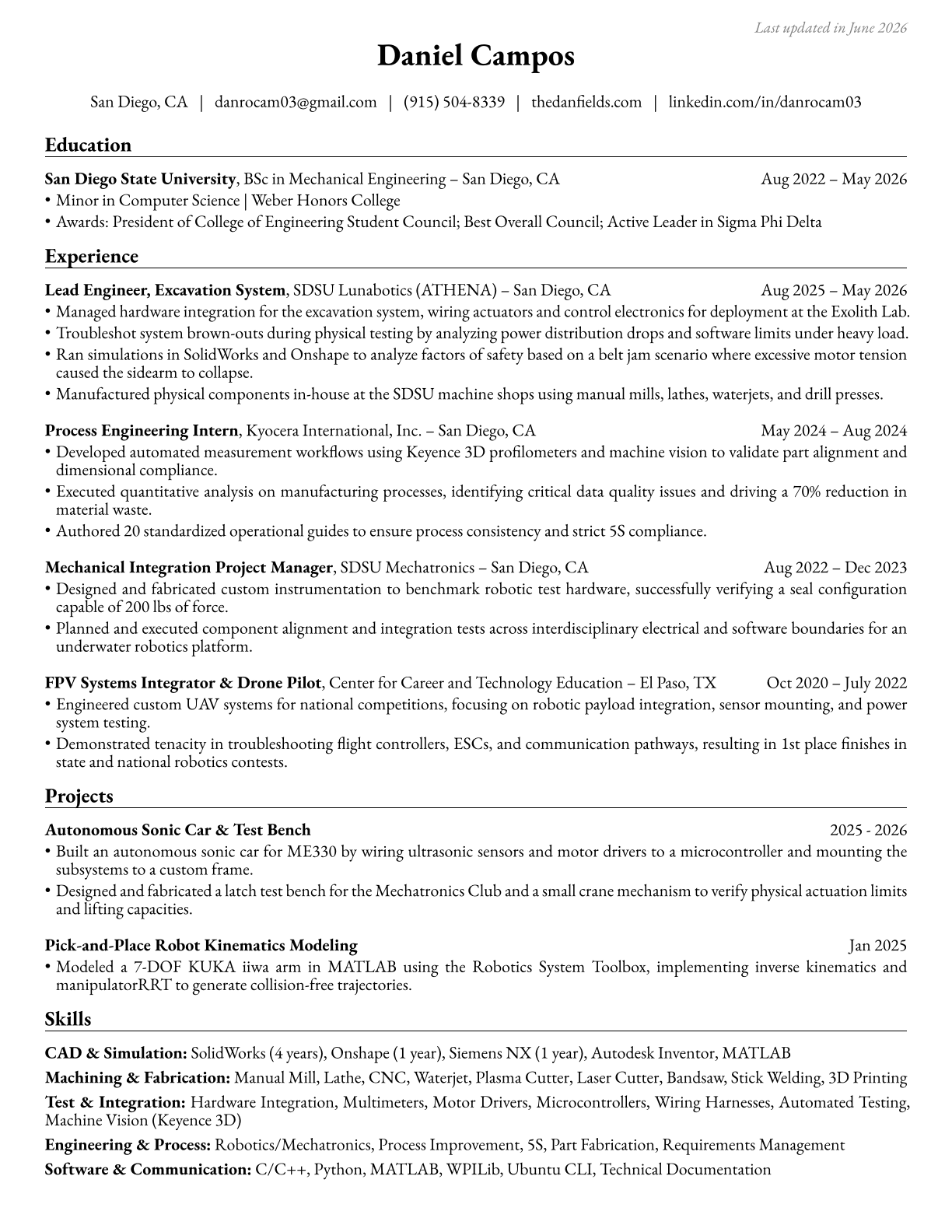
Recent ME grad looking to work on robotics and electromechanical hardware. This site is a collection of my design reports, CAD models, competition builds, and work from my internships.
Click the resume to download a PDF copy.
SDSU LUNABOTICS COMPETITION TEAM
ATHENA is a competitive lunar rover built for the NASA Lunabotics program and ran in the highly abrasive regolith (lunar soil) at the Exolith Lab and Kennedy Space Center Swamp Works lab. Despite being a completely new, first-year team with zero returning members or prior competition experience to lean on, we placed 5th out of 73 teams nationwide.
As the Lead Engineer for the excavation system, my job was to design, manufacture, and integrate the physical hardware that digs the regolith. I ran simulations in SolidWorks and Onshape to ensure our load-bearing linkages could withstand extreme torque spikes, specifically basing our factors of safety around a worst-case belt jam scenario where the motors would attempt to over-tension and collapse the sidearm. I manufactured the components in-house at the SDSU machine shops using waterjets, manual mills, and lathes. On the electromechanical side, I routed the wiring for the actuators and control electronics and spent our physical testing sessions tracking down system brownouts and fixing hardware failures when the rover was pushed to its limits.
KUKA iiwa 7-DOF Manipulator
Pick-and-Place Kinematics Modeling
KUKA LBR iiwa 7 R800 (Image via Robots.com)
Modeled KUKA Robot Arm (Orange) movement through the multi-layer environment with obstacles.
To execute a real-world pick-and-place operation, a robotic arm must navigate complex workspaces without colliding with the environment or itself. Using MATLAB's Robotics System Toolbox, I stripped the standard URDF collision meshes from a 7-axis KUKA iiwa manipulator, rebuilt a simplified custom collision architecture, and generated collision-free inverse kinematics paths across a multi-tiered obstacle course.
This project models the collision-free trajectory of a 7-degrees of freedom KUKA iiwa robotic manipulator in MATLAB. The objective was to compute an inverse-kinematics path that moves target objects between platforms inside a dense obstacle environment without the arm colliding with itself or the surroundings. Built using the MATLAB Robotics System Toolbox, the motion planning stack combines a numerical Inverse Kinematics solver (inverseKinematics) with an RRT obstacle planner (manipulatorRRT), passing the resulting waypoints through a pchip polynomial algorithm to give smooth and continuous joint movement.
Environment & Kinematic Setup
Instead of building a rigid-body tree link by link, the pre-structured URDF model was loaded directly into the workspace. To optimize the computational speed of the collision-checking algorithm, the imported visual meshes were stripped and replaced with simplified custom primitives (collisionBox, collisionCylinder, and collisionSphere).
The simulated workspace contained three separate landing platforms, two vertical obstacle pillars, and two spherical target objects:
Denavit-Hartenberg (DH) Parameters — KUKA iiwa 7-R
Serial manipulator joint frame assignments and Jacobian derivatives (Fu & Spyrakos-Papastavridis, 2020).
| Joint (i) | Type | Twist (α) | Length (a) | Offset (d) | Angle (θ) | Role |
|---|---|---|---|---|---|---|
| 1 | Revolute | 0° | 0 mm | 360 mm | θ₁ | Base Rotation |
| 2 | Revolute | -90° | 0 mm | 0 mm | θ₂ | Shoulder Pitch |
| 3 | Revolute | +90° | 0 mm | 420 mm | θ₃ | Shoulder Roll |
| 4 | Revolute | +90° | 0 mm | 0 mm | θ₄ | Elbow Pitch |
| 5 | Revolute | -90° | 0 mm | 400 mm | θ₅ | Elbow Roll |
| 6 | Revolute | -90° | 0 mm | 0 mm | θ₆ | Wrist Pitch |
| 7 | Revolute | +90° | 0 mm | 126 mm | θ₇ | End-Effector Roll |
Algorithmic Motion Planning
The simulated cycle was broken into three sequential routines: home-to-pick, object grasp, and pick-to-place.
A numerical solver was weighted heavily toward Cartesian positional accuracy over joint orientation to successfully converge on reachable grasp coordinates above the spheres.
Waypoints were mapped through a Rapidly-exploring Random Tree planner (manipulatorRRT) with self-collision checking enabled to navigate around the obstacles in the environment, such as the vertical pillars or platforms.
Since the raw RRT output creates jagged, instantaneous directional shifts, the waypoints were passed through a pchip interpolation algorithm. This generated 200 continuous frames of motion, preventing infinite jerk on the simulated actuators.
Technical Bottlenecks & Debugging
Developing the solver required resolving several common manipulator edge-cases:
Early iterations caused the manipulator to pass directly through the square obstacle pillars. This was resolved by re-centering the primitive bounding boxes relative to the link coordinate frames.
When target coordinates sat near the outer boundary of the workspace, the solver would terminate early or generate erratic "hunting" motions before settling on a trajectory. Tuning the RRT step-size thresholds (MaxConnectionDistance = 0.2, ValidationDistance = 0.05) stabilized path convergence.
SELF-HOSTED CLOUD INFRASTRUCTURE
Private Linux File Server & Tailscale Tunneling
This project covers the deployment and ongoing administration of a private, self-hosted Nextcloud file server built to replace commercial cloud storage subscriptions. The objective was to make a secure, 4-Terabyte remote storage vault running on repurposed desktop hardware in El Paso, Texas, accessible transparently across Windows, Android, and mobile devices. Built on a headless Ubuntu Server command-line interface, the system bypasses traditional home router port-forwarding by routing all client synchronization, Windows WebDAV mounting, and remote SSH terminal management exclusively through an encrypted Tailscale WireGuard mesh tunnel.
Class files being accessed from an Android Phone
During my time at myCREcloud, I deployed enterprise QNAP file servers, configured Proxmox hypervisors for remote virtual machines, and managed user permissions across Windows Domain Controllers. This exposure to IT infrastructure highlighted the potential of self-hosted networking.
Concurrently hitting the storage ceiling on my commercial cloud accounts, I repurposed an unused desktop tower pc sitting 700 miles away in my hometown of El Paso, Texas. The personal challenge was to step away from graphical interfaces and build a headless Linux environment managed exclusively via command line.
System Architecture & Security
The server is built on an Ubuntu CLI environment. Navigating conflicting apt and snap package configurations required several full system tear-downs before getting a stable Nextcloud deployment.
Rather than relying on traditional port-forwarding, which exposes home router IP addresses to automated botnet scanners, remote access is routed exclusively through Tailscale. This creates an encrypted peer-to-peer mesh network, allowing me to SSH into the Host machine in El Paso or access files from anywhere over standard Wi-Fi or cellular data through the Nextcloud app.
Class Files being access from a windows computer via the file explore
Configured Windows WebDAV integration to mount the remote El Paso server natively inside Windows File Explorer as a local drive, while utilizing Nextcloud mobile clients to automatically ingest and consolidate over a decade of archived phone photography into a single unified database.
Technical Bottlenecks & Roadmap
Binary Dependency Mapping: Server-side automated facial and object recognition is currently offline. The Nextcloud instance fails to recognize the active system Node.js binary path despite the installed package matching the version requirement. Troubleshooting is ongoing to resolve the environment variable mapping.
Future Hardware Acceleration: Once the Node.js pipeline is stabilized, the objective is to offload the image processing models from the host CPU to the dedicated system GPU to reduce background indexing overhead.
Lack of Data Redundancy: The 4TB storage array currently operates as a single point of failure (JBOD) with zero RAID parity mirroring. Mitigating this risk by implementing an automated off-site backup cron job or converting the storage pool into a ZFS mirrored array is the highest priority for the next hardware iteration.

EXPERIENCE




-
Elected President after serving as VP of Programming; led council supporting 33 RSOs, representing ~3,500 students, and managed a $37K annual budget.
Implemented cost-recovery event models to make select programming events budget-neutral. Developed an industry sponsorship package to expand compliant funding channels for RSOs.
Scaled operations and reduced member burnout by establishing 5 committees (Programming, Marketing, Outreach, Academic Affairs, Internal Affairs) and delegating initiative ownership.
Partnered with other College Councils to restore 24/7 library access, gathering and compiling feedback from 190 students.
Identified course availability bottlenecks that could delay graduation and partnered with departments to add sections and adjust schedules to remove conflicts.
Planned and executed major events (Pumpkin Drop, Engineering Week) and hosted SDSU’s largest Order of the Engineer ceremony. (300 attendees + livestream)
Council recognized by the National Association of Engineering Student Councils: Most Outstanding Council and Best Social Event awards.
-
Brought Change Control Boards (CCBs) to a higher operating maturity by enabling KPI reporting at the individual-board level, reporting first-time-right and task cycle time to benchmark performance and target improvements.
Rebuilt KPI reporting via end-to-end data lineage mapping, reducing redundant KPI inputs from 32 to 9 and improving data consistency.
Aligned ~15 CCBs to System Functions and standardized how inputs feed metrics, expanding granular KPI coverage across boards.
Interviewed 26 SMEs to diagnose cross-sector training gaps. Validated training statuses and uncovered training reporting discrepancies (known completed training showing as incomplete), escalated findings to leadership, and launched a searchable Q&A hub as an interim knowledge source.
Supported ISO 9001 QMS audit readiness by translating the change-control RACI into a clear process map (issue types, required tools/documents, stage owners, and decision gates) for the EUV change pipeline.
Reduced internal friction by locating and sharing an authoritative Scrum team roster (scrum masters + team membership) when org ownership/structure was unclear, improving cross-team routing and communication.
-
Served guests at the counter and drive-thru using an iPad and radio, processing about 120 orders per shift with high accuracy by confirming each order; relied on as the go-to order taker during rushes.
Earned many “Above and Beyond” customer compliments; resolved order issues on the spot to keep lines moving and guests satisfied.
Regular opener: counted cash drawers, set up stations, stocked supplies, and labeled food with expiration dates to meet rotation and safety standards.
Balanced ~20 hours per week while a full-time student involved in extracurriculars with consistent attendance and reliability.
-
Initiated a study to reduce spending on firing tape used in cofiring.
Utilized automated dimensional data acquisition with 3D profilometers ensuring parts remain within specifications across various tests.
Achieved an average savings of ~80% from original spending, saving upwards of $50k a year - Lean of Lean Six Sigma
Conducted foreign material analysis within the greenside cleanroom to improve defect loss.
Issues test strips to determine sources of FM inside and outside machines. Eliminated and issued repairs for problematic items.
Wrote and created illustrations for detailed work instructions depicting proper cleaning methods for various machines and processes in the cleanroom. Worked with production, plant engineering, and the plant technology center to ensure sustainability, safety, and efficiency of the work instructions. - Six Sigma of Lean Six Sigma
-
Collaborating with graduate students to research manufacturing methods of foamed metals using the Powder Compact Metal Foaming process.
Preparing mixed powders via tumbling and ball milling, optimizing particle size distribution, and performing powder compaction through uniaxial dry pellet pressing in a hydraulic press, utilizing diamond suspension polished dies.
Analyzing green body surface morphology and grain size via microscopy and image processing with ImageJ.
Conducting metal foaming and quantified density changes using Archimedes' principle.
-
Providing Tier 1 technical support to clients via phone and email, resolving a wide range of issues related to managed services and cloud deployments.
Utilizing Veeam to manage both on-premises and off-site data backups, ensuring accuracy and data integrity.
Maintaining company data integrity and accessibility by importing, organizing, and updating information on IT Glue, Datto, and SharePoint.
Managing and distributing software license keys, ensuring compliance, and optimizing resource allocation.
Troubleshooting remote desktop servers and basic QNAP server configurations.
Building and configuring client-ready computer systems, demonstrating attention to detail and efficient workflow.
-
Successfully managed all aspects of the business from contract negotiations and invoicing to price discussions, ensuring a seamless experience for clients.
Captured and edited a diverse range of projects including assignments for esteemed clients like the Hal Marcus Gallery, St. Paul's United Methodist Church, and multiple memorable weddings, delivering high-quality, personalized visual content that exceeded expectations
-
Proficient in surveying and photogrammetry using Pix4D, with a strong capability in acquiring and analyzing aerial data
Skilled in operating and maintaining flight equipment, including flight controllers, electronic speed controllers, soldering, BetaFlight programming, and adept at troubleshooting technical issues.
Achieved excellence by designing and racing FPV drones, placing first place in both State and National competitions for SkillsUSA and the Technology Student Association (TSA).
Full Torsion Bar Assembly Summary
HIGH-LOAD TORSION BAR SUSPENSION
Suspension Design for a 5,750 lb SUV
Designed to handle rough terrain on a heavy passenger SUV, this 4130 steel torsion bar acts as a compact, high-torque spring. Sweeping across a 4-degree lever arm range, the shaft absorbs an average 1,700 lbf dynamic wheel load while protecting its root splines from shear failure.
Specifications
Target Vehicle is a ~5,750 lb SUV (e.g., Ford Bronco) supporting 1,500 lbf static weight per wheel
The Shaft is a 145-inch hollow bar with a 2.15-inch inner diameter and 2.751-inch outer diameter
Factor of safety of 10.41 in static torsion against a 1.15 baseline requirement
Spline Interface has a ANSI B92.1 20-tooth involute profile with a 30° pressure angle
Range of Motion of the Lever Arm
Because the system relies on a fixed steel shear modulus, the bar's inner and outer diameters strictly dictate its travel suspension. Tuning those dimensions allowed the bar to absorb 889.6 lbf at its 47° minimum operational angle and 2,511.6 lbf at its 51° maximum bottom-out angle.
Torsion Bar Validation - Goodman Fatigue & Joint Stiffness
Dynamic Fatigue Failsafes
S-N Fatigue Graph for 4140 Q&T 205°C 400°F Torsion bar.
To protect against severe highway washboarding, the shaft was modeled against a fully reversed modified Goodman fatigue criterion rather than standard unidirectional cyclic loading.
Surface Finish Salvage: Specified a precision ground finish (a = 1.34, b = -0.085) to preserve the bending endurance limit.
Fatigue Margin: Cleared the critical fatigue threshold with a 2.71 factor of safety at 99.9% reliability.
Spline & Fitting Optimization
Torsion Bar Detail
Fixed Coupling Detail
Spline Tooth Shear: Sized the outer shaft diameter down to 2.673 inches to minimize polar moment of inertia, clearing tooth shear at a lean 1.058 safety factor.
Bearing Support Lug will be machined from a single 0.5-inch thick block of 3003-H16 aluminum to resist offset loading, yielding a 4.16 safety factor.
Joint Separation: Sized SAE Grade 2 mounting bolts to hold a 2,862 lbf preload, maintaining a joint separation margin of 4.46.
Bearing Support Detail Dimensions
Distributed Load, Shear Force, and Moment Diagrams of Axle
Distributed Load Diagram of Axle
Shear Force Diagram and Bending Moment Diagram for Axle
AIRCRAFT ACCESSORY GEARBOX
Packaging 4 Systems Under a 260 lbf Limit
Modern commercial aircraft engines pack massive power into tight, curved spaces. Integrated directly beneath the compressor casing, this accessory drive gearbox takes 750.3 in-lbf of input torque at 8400 RPM from the turbine transfer shaft and splits it to drive four vital flight systems simultaneously.
Specs:
Input Power of 750.3 ± 0.5 in-lbf delivered at 8400 RPM
Total Weight of 248.72 lbf achieved against a 260 lbf maximum ceiling
15 meshing spur gears and 1 input bevel gear forged from Nitralloy 135 M
Shaft made of AISI 1050 steel Q&T sized for infinite fatigue life
Packaging
Accessory Component Locations
Fitting a 4.75-inch wide gear train inside the curved profile of an engine compressor casing required compounding three sets of gear shafts. The system was tuned to hit four distinct component target speeds:
Oil Pump: 259.5 in-lbf delivered at 8500 RPM
Fuel Pump: 252.1 in-lbf delivered at 7504 RPM
Electrical Generator: 193.9 in-lbf delivered at 6503 RPM
Hydraulic Pump: 270.1 in-lbf delivered at 3500 RPM
Gearbox Validation - AGMA Stress & Neuber Shaft Analysis
AGMA Gear Stress Validation
Shear And Bending Moment Diagrams For Drive Shaft (Portion Inside Gear Box, Gears 2 and 9)
All 16 gears were designed to AGMA No. 10 quality standards under moderate shock loading. Nitralloy 135 M was selected across Grades 1 through 3 to optimize contact and bending strength post-nitration. Gear 9 exhibited the lowest bending safety factor at 1.36 against a 1.30 project requirement. Gear 9 also represented the primary pitting risk, clearing the allowable contact threshold with a 3.07 safety factor.
Shaft Fatigue & Stress Concentrations
S-N Curve of 1050 Steel Q&T 400F at the Most Loaded Location of the Drive Shaft
The assembly utilizes twelve uniform 1-inch outer diameter shafts to standardize bearing depths. The main input drive shaft absorbed the most severe compound loads:
Retaining Ring Grooves: Achieved a 1.639 safety factor calculated via Neuber shear and bending constants.
Keyway Joints: Cleared dynamic loading with a 1.987 safety factor.
S-N Life Assessment: Plotted onto the 1050 Steel Q&T 400°F curve, proving the shaft operates strictly in its infinite life zone.
Shear and Bending Moment Diagrams
Shear And Bending Moment Diagrams For Drive Shaft (Portion Inside Gear Box, Gears 2 and 9)
Shear And Bending Moment Diagrams For Drive Shaft (Portion Outside Gear Box, Bevel Gear)
The last day of my Internship at ASML with the Configuration Management Team
Behringer, my son.
Accepting the Outstanding Council Award on behalf of our board during my 2025–2026 Presidency.
Cave Exploring in Julian CA